
The Full Mechanics of the Round
A deep look at how the multiplier is generated, what the 97% RTP and x10000 ceiling really mean, and why every crash point is fair and verifiable.
Contents
The Crash Engine Explained
The round runs on one hidden number: the crash point. Before a round begins, the engine has already picked — using a random number generator — the exact multiplier where the round will end. You don't get to see this value. Once the round starts, a visible multiplier climbs toward that fixed crash point, and the moment it gets there, the round stops.
Because the crash point is set the instant the round opens, nothing you do during the round can move it. What you do control is timing: how long you let the multiplier rise before you cash out. That's where any real decision happens.
RTP, House Edge and What 97% Means
The main number to know is the return to player (RTP) of 97%. Across millions of rounds, the game is built to return about ₹97 for every ₹100 wagered, which leaves a 3% house edge. This is a long-run average, not a forecast for your next session. Over a short run you might win much more than 97% or much less — the figure only settles down over a very large number of rounds.
Even so, the number matters when choosing a crash game. A 97% RTP is on the generous end of the genre; plenty of older crash clones sit at 95% or below. A higher RTP means the maths is a little kinder over time, which is exactly why informed players gravitate toward titles in this range.
The Multiplier Curve and Volatility
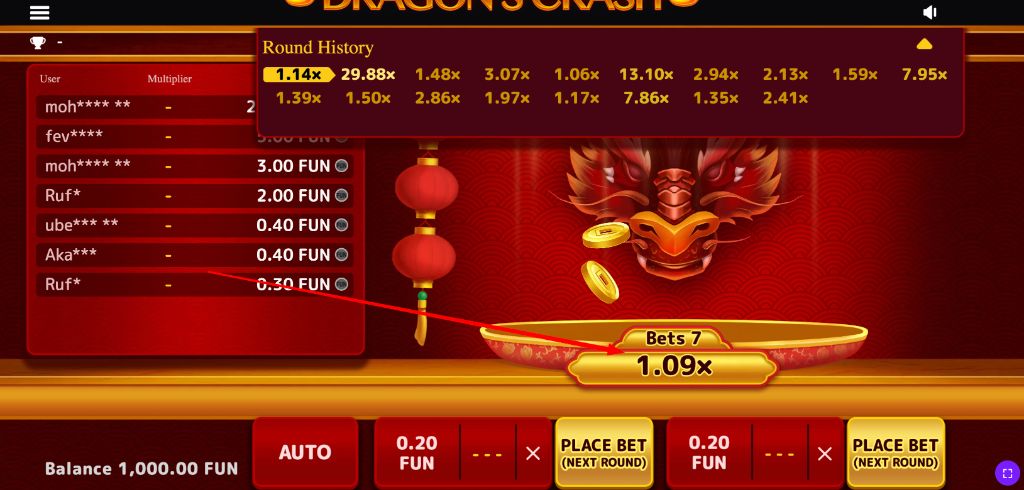
The curve does not rise linearly. It starts slowly near 1.00x and then accelerates, which is why early multipliers feel safe and high ones feel dizzying. Because this title is classified as high volatility, the distribution of crash points is uneven: a large share of rounds end early, below 2x, while a small minority sail up into double or triple figures.
That shape changes how you should play. If you always hold out for a huge multiplier, most rounds will crash before you get there and your balance drains during the dry spells. If you cash out early and often, you win regularly but in small amounts. High volatility just means the big wins come less often, while the gaps between them test your patience. Get a feel for this curve and most of your other decisions fall into place.
I logged the crash points across roughly 300 demo rounds while researching this page, and the spread matched the high-volatility label almost exactly: more than half ended below 2x, and only a handful crept past 10x. Writing those numbers down myself was what finally convinced me to stop chasing the rare big spikes and play the early cash-out more often.

The x10000 Ceiling
Every crash game has a maximum multiplier, and here it's a generous x10000. If a round somehow climbs all the way to that ceiling, it resolves and pays at the cap. Reaching anything near four figures almost never happens, but having the ceiling there at all keeps the long-shot appeal alive — a tiny stake could, in theory, come back ten thousand times over.
For the overwhelming majority of rounds, though, the ceiling is academic. Most of the action happens between 1x and roughly 10x, and that is where almost all real decisions are made. Treat the x10000 figure as the upper bound of possibility rather than a realistic target.
Provably Fair: How Randomness Is Proven
"Provably fair" isn't just a label. The engine uses a certified random number generator to set each crash point, and it does so in a way you can check afterward. Before the round, the system locks in a hashed value; after the round, it reveals the seeds. That lets anyone confirm the crash point was decided in advance and never changed once bets were in.
For trust, that's the part that matters. Neither the operator nor the player can nudge the result mid-round, and it answers the usual worry that a crash game might be rigged behind the scenes. You can verify the fairness yourself, which is the bar a decent crash title should clear.
How Payouts Are Calculated
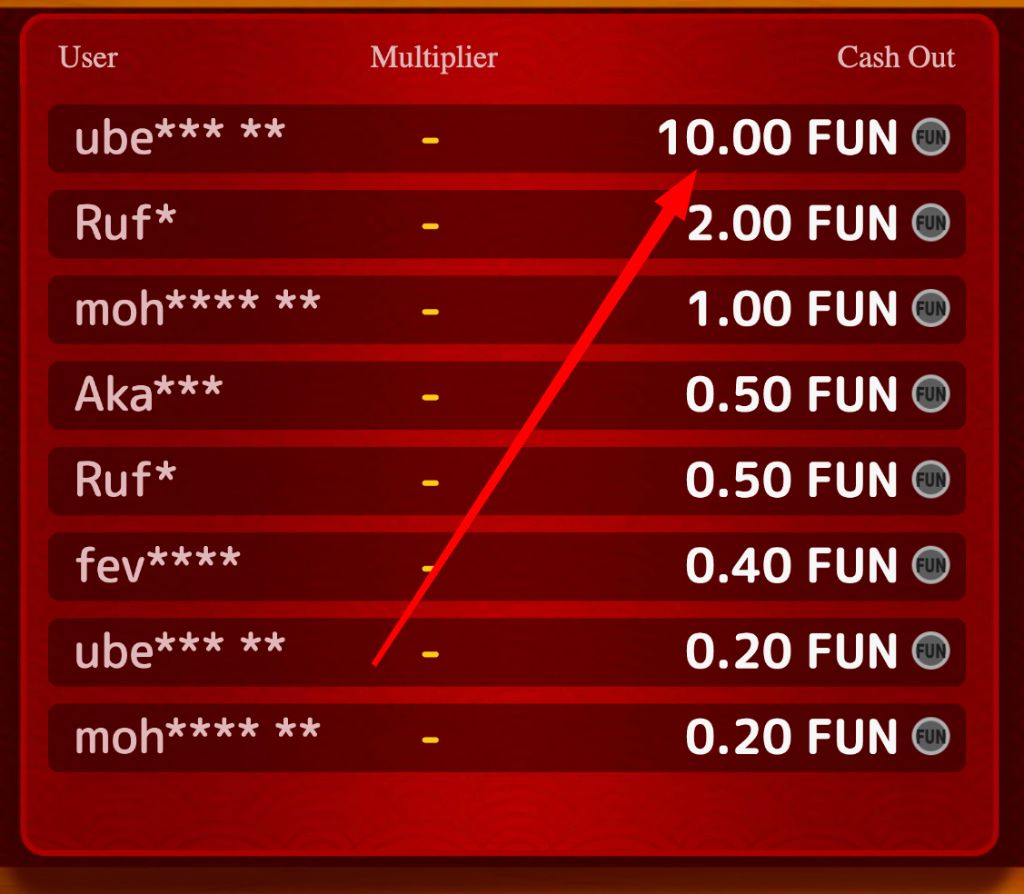
The payout maths is straightforward: your payout is your stake times the multiplier at the moment you cash out. Stake 1.00 FUN and cash out at 2.50x, and you get 2.50 FUN. Cash the same stake out at 7.95x and you collect 7.95 FUN. If the round crashes first, the multiplier no longer matters and the stake is gone.
Because the relationship is purely multiplicative, doubling your stake doubles every possible outcome — both the wins and the losses. This is why bankroll discipline matters more than any clever trick: the engine treats every coin identically, so the only lever that changes your risk is how much you choose to wager and when you choose to leave.
Multiple Bets in a Single Round
One handy feature is running two separate bets at once. Plenty of players use it to balance risk: cash the first bet out early for a small, near-certain win, then let the second one ride in the hope of a bigger multiplier. It's a simple way to hedge — you take something on most rounds while still leaving a shot at the big payouts.
You'll see this in the interface as twin bet panels and a "Bets" counter on the tray that shows how many wagers are live in the round. Pair it with auto cash-out and the dual-bet system adds more depth than you'd expect from what looks like a one-button game.
Theory done — go feel the curve
The maths only truly clicks once you watch a few rounds rise and crash for yourself in the free demo.